
VAT Input Credit, Refunds, and the Consequences of Huge Input Tax Credit in the UAE
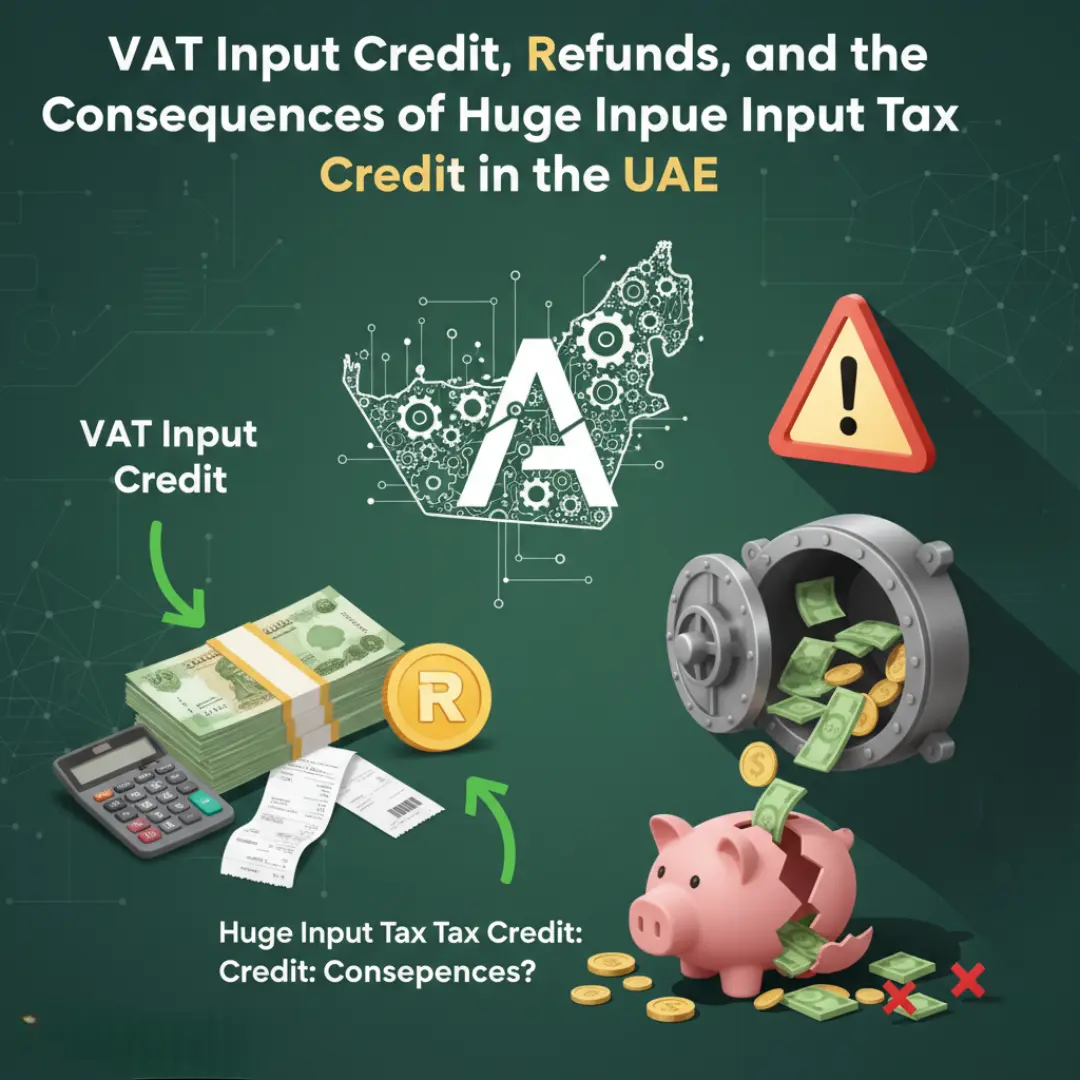
One of the biggest advantages of being a VAT-registered business in the UAE is the ability to recover VAT paid on business expenses — known as Input VAT Credit. This ensures VAT is ultimately borne by the end consumer, not by businesses in the supply chain.
However, when a company repeatedly accumulates large Input Tax Credit (ITC) or files frequent refund claims on the FTA (Federal Tax Authority) portal, it can invite additional scrutiny. Errors, unsupported invoices, or incorrect apportionment can result in delays, disallowances, or even penalties.
This article by Accruon Auditing LLC explains how VAT input credits and refunds operate under UAE law, and the consequences of maintaining unusually high credit balances in the FTA system.
1. Understanding VAT Input Tax Credit
Input VAT is the tax paid on goods and services purchased for use in taxable business activities.
Output VAT is the tax collected on sales to customers.
The difference between the two — output minus input VAT — determines the tax payable or refundable. When input VAT exceeds output VAT, the excess becomes a credit balance.
Eligibility to Claim Input VAT (as per UAE VAT Law)
Under Federal Decree-Law No. 8 of 2017 and Cabinet Decision No. 52 of 2017, businesses can claim input VAT if:
- The goods or services are used to make taxable or zero-rated supplies (not exempt).
- A valid tax invoice is available containing all mandatory details (Article 59, Executive Regulations).
- The consideration has been paid or there is an intention to pay the supplier.
- The supplier and recipient are both VAT-registered.
- The purchase is not within blocked input categories, such as entertainment, personal expenses, or exempt supplies.
If any of these conditions fail, the input VAT must be reversed or adjusted in a subsequent VAT return.
2. When Input Tax Exceeds Output Tax
In some cases — such as during expansion, major procurement, or export operations — input tax may exceed output tax.
Businesses then have two options under UAE VAT Law:
- Carry Forward: Offset the excess input VAT against future tax liabilities.
- Request Refund: File a refund application via the FTA’s e-services portal.
3. VAT Refund Process through the FTA Portal
When applying for a refund, accuracy and documentation are critical.
Steps to Apply for VAT Refund:
- File the VAT Return (Form 201) — Report all sales, purchases, and input/output tax.
- Access Form VAT311 — “VAT Refund Request” available in the taxpayer’s FTA portal account.
- Submit Supporting Documents — Invoices, payment proofs, contracts, customs import/export declarations, etc.
- FTA Review — The FTA examines refund claims and may request clarifications or documents.
- Approval & Disbursement — Refunds are processed within approximately 20 business days, either by bank transfer or offset.
Reference:
- Article 65 of the Executive Regulations
- FTA VAT Refund User Guide, Version 4.0 (August 2021)
4. Consequences of Huge Input Tax Credit in the FTA Portal
While a high input tax credit might seem beneficial, it can lead to challenges if not justified properly.
1. Heightened FTA Scrutiny
Frequent or large credits may trigger audits or refund verification. The FTA may review your purchase ledgers, supplier TRNs, and payment records in detail.
2. Delays or Rejections of Refunds
Refunds may be delayed or disallowed if documentation is incomplete, invoices are invalid, or the credit relates to non-business or exempt activities.
3. Reversal of Credit & Voluntary Disclosure
If it is later discovered that the supplier wasn’t paid within 6 months or the invoice was incorrectly claimed, you must reverse the input VAT or file a Voluntary Disclosure (Form 211).
4. Administrative Penalties
Under Cabinet Decision No. 49 of 2021, incorrect or overstated VAT returns attract penalties, including:
- AED 10,000 for incorrect disclosure, and
- Percentage-based penalties on unpaid or over-claimed tax.
5. Cash Flow Constraints
Refunds under FTA review may take time, tying up working capital and affecting liquidity — especially for exporters or contractors.
6. Compliance Reputation
Consistent refund scrutiny may affect your business’s risk profile with the FTA, potentially delaying future claims.
5. Best Practices for Managing Input VAT Credit
To remain fully compliant and avoid risks of reversal or penalties:
- Ensure every purchase has a valid FTA-compliant tax invoice.
- Reconcile supplier records and match purchase invoices with VAT returns each period.
- Maintain payment proof for all claimed invoices.
- Perform apportionment where purchases relate partly to exempt supplies.
- File voluntary disclosures promptly for any identified errors.
- Retain records for at least five years (Article 78, VAT Law).
- Seek professional VAT health checks or compliance audits periodically.
6. Conclusion
Claiming VAT input credit is a key right under UAE VAT Law — but exercising it responsibly is equally important.
A persistently high or unjustified input tax balance can invite FTA audits, refund delays, and penalties.
With structured documentation, accurate reconciliation, and professional oversight, businesses can ensure faster refunds, stronger compliance, and better cash-flow management.
At Accruon Auditing LLC, our VAT specialists assist clients with:
- VAT registration and return filing
- Input VAT reconciliation
- Refund claims and documentation
- FTA audits and voluntary disclosures
We help you recover what you deserve — while ensuring 100% compliance with UAE VAT regulations.