
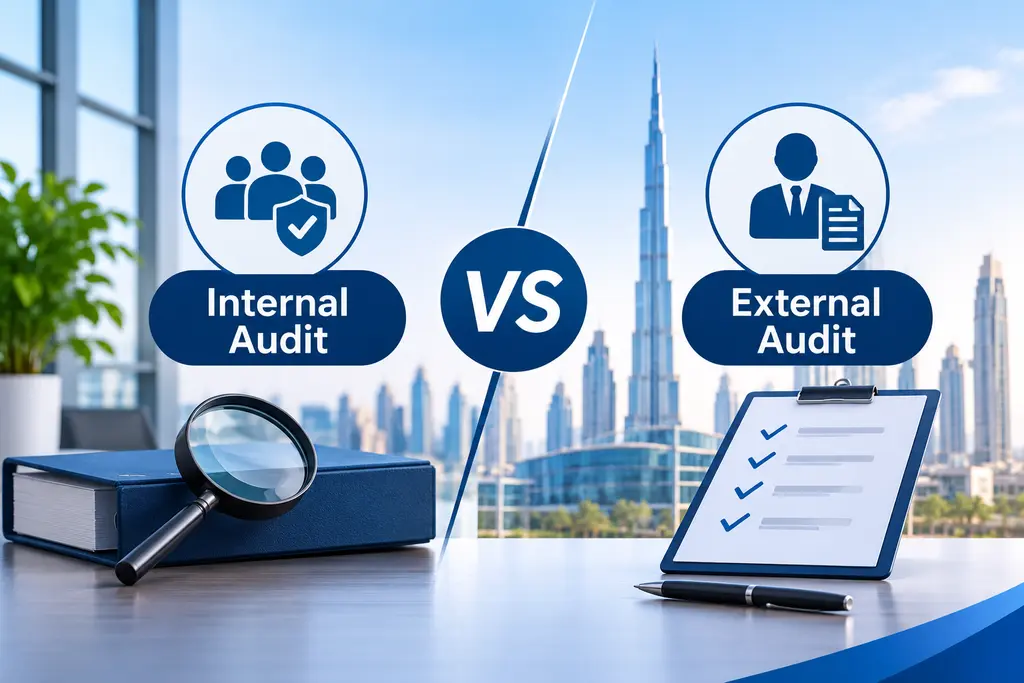
Most SME owners in the UAE meet the word “audit” in one of three ways: a licence renewal notice, a bank request, or a corporate tax return. Few are told which audit they need, or why.
That confusion is costly. Some businesses pay for work they do not need. Others skip an audit the law requires. Understanding internal audit vs external audit in the UAE terms solves both problems.
This guide explains what each audit does, who must have one in 2026, what it costs, and how to decide. It is written for SME owners, finance managers, free zone and mainland directors, and founders planning a UAE setup.
Internal Audit vs External Audit in UAE: The Core Difference
The difference between internal audit and external audit comes down to who the work is for.
- An external audit is an independent opinion on your financial statements. It serves outsiders: regulators, banks, investors and the tax authority.
- An internal audit is a review of how your business runs. It serves you: owners, directors and management.
One checks whether the numbers are fairly presented. The other checks whether the processes behind those numbers can be trusted.
| Point | Internal audit | External audit |
|---|---|---|
| Main purpose | Improve controls, reduce risk | Give an opinion on financial statements |
| Reports to | Owners, board, management | Shareholders and regulators |
| Performed by | In-house team or outsourced firm | Independent registered auditor |
| Scope | Chosen by the business | Set by law and auditing standards |
| Timing | Throughout the year | Once a year, after year-end |
| Legally required for SMEs | Usually no | Often yes |
| Output | Findings and recommendations | Signed audit report |
Internal Auditor vs External Auditor Roles
The internal auditor vs external auditor roles differ in practice too.
An external auditor tests balances, confirms figures with third parties and signs a formal report. They must stay independent, so they cannot design your systems or run your accounts.
An internal auditor walks through your processes. They test approvals, stock counts, payroll, purchasing and cash handling, then tell you where money or data could leak.
Is Audit Mandatory for SMEs in UAE?
The question is audit mandatory for SMEs in UAE has no single answer. Three separate rules apply, and passing one does not excuse you from another.
Mainland Company Audit Requirements UAE
The UAE Commercial Companies Law audit requirement applies to mainland limited liability companies and joint stock companies. They must appoint a registered auditor and have their annual accounts audited, whatever their revenue.
So mainland company audit requirements UAE owners face do not depend on size. A small LLC is covered in the same way as a large one. Branches of foreign companies are generally covered as well.
Free Zone Audit Requirements UAE
Free zone audit requirements UAE wide are set by each free zone authority. Most ask for audited financial statements at licence renewal, and many accept reports only from their own list of approved auditors.
Check two things with your authority: the submission deadline after year-end, and whether your auditor is on its list. You can see where Accruon is listed on our approved free zone authorities page.
Audited Financial Statements for UAE Corporate Tax
The audited financial statements UAE corporate tax rule sits in Ministerial Decision No. 84 of 2025. It applies to:
- Taxable persons with revenue above AED 50 million in the tax period
- Every Qualifying Free Zone Person, whatever its revenue
- Tax groups, which prepare audited special purpose financial statements
For free zone companies, the audit is also a condition of the 0% rate. Our guide to free zone corporate tax and QFZP rules explains why a missed audit can cost five years of that benefit.
Do Small Businesses Need an Audit in UAE?
So, do small businesses need an audit in UAE? In most cases, yes, for at least one of these reasons:
- You are a mainland LLC.
- Your free zone asks for audited accounts at renewal.
- You claim the 0% free zone rate.
- Your bank, investor or landlord requires signed accounts.
Sole establishments and some small free zone entities may fall outside all three rules. Even then, banks often ask for audited accounts before opening facilities.
External Audit Requirements UAE 2026: What the Auditor Checks
Under external audit requirements UAE 2026 rules, the work follows International Standards on Auditing, and accounts are prepared under IFRS or IFRS for SMEs.
The statutory audit requirements in UAE law mean your auditor will typically ask for:
- Trial balance, ledgers and bank statements
- Sales and purchase invoices, with contracts
- Fixed asset and inventory records
- Payroll and end-of-service calculations
- Related-party transactions and balances
- VAT and corporate tax filings
The auditor must be registered with the UAE Ministry of Economy. Choosing from approved auditors in UAE lists matters, because a report from an unlisted firm can be rejected at licence renewal.
For the full scope, see our statutory audit services in the UAE.
Internal Audit for SMEs in UAE: When It Is Worth Paying For
Internal audit for SMEs in UAE is rarely a legal duty. It is mainly required for listed and regulated entities such as banks and insurers. For everyone else, it is a management choice.
It becomes worth the cost when the business outgrows the owner’s direct oversight. Common triggers are:
- More than one branch, warehouse or outlet
- High cash or inventory volumes
- Rapid hiring, with new staff handling payments
- A suspected fraud or unexplained stock loss
- Preparation for investors, a sale or bank financing
- Repeated qualifications or findings in the external audit
Benefits of Internal Audit for Small Businesses
The benefits of internal audit for small businesses are practical:
- Fraud and error are caught early, not at year-end.
- Internal controls for SMEs in UAE improve, such as separating who approves, pays and records.
- The external audit runs faster, with fewer queries.
- VAT and corporate tax records hold up better in a tax authority review.
- Owners get an unbiased view of what staff are doing.
Example: A Dubai trading company with two warehouses found a stock gap of several hundred thousand dirhams at year-end. The external audit reported the difference. A later internal audit found the cause: one employee both received goods and updated the stock system. Splitting those duties fixed it.
Outsourced Internal Audit UAE
Few SMEs can justify a full-time internal auditor. Outsourced internal audit UAE arrangements solve this. A firm reviews selected areas each quarter or half-year and reports directly to the owner.
This approach links internal audit and risk management UAE businesses need, without adding headcount. Our internal audit and risk management services are built for this model.
Audit Cost for SMEs in Dubai
Audit cost for SMEs in Dubai depends on size, transaction volume and the state of the books. As a guide, an external audit usually ranges from AED 5,000 to AED 50,000 or more per year.
Internal audit is priced by scope: the number of processes, locations and visits. A single-process review costs far less than a full annual plan.
Clean bookkeeping reduces both fees. If you are comparing providers of external audit services in Dubai, our review of the top audit firms in Dubai lists what to check.
Which Audit Does My Business Need in UAE?
If you are asking which audit does my business need in UAE, use this quick guide:
| Your situation | What you need |
|---|---|
| Mainland LLC, any size | External audit every year |
| Free zone company claiming 0% | External audit every year |
| Free zone company, authority requires accounts | External audit by an approved auditor |
| Revenue above AED 50 million | External audit, plus internal audit strongly advised |
| Multi-branch, cash-heavy or fast-growing SME | External audit, plus outsourced internal audit |
| Small, owner-run, single location | External audit where required; a one-off controls review is enough |
In short, most SMEs need the external audit by law and the internal audit by choice. The two do not replace each other.
A company claiming the free zone rate should also consider a free zone compliance audit, which covers the authority’s requirements and the tax condition together.
Final Thoughts
An external audit tells others your numbers can be relied on. An internal audit tells you whether your business can be relied on. In 2026, most UAE SMEs must have the first and will benefit from the second once they grow beyond one location or one decision-maker.
Accruon Auditing LLC is a government-approved audit firm in Dubai, led by Chartered Accountants with over 20 years of experience and listed with major UAE free zone authorities. We provide both external and internal audit services in Dubai, so one team can cover your full audit needs.
Not sure which audit applies to your company? Get a free consultation with Accruon Auditing LLC or call +971 4 256 7329, and we will confirm your requirements before your next renewal or filing.