
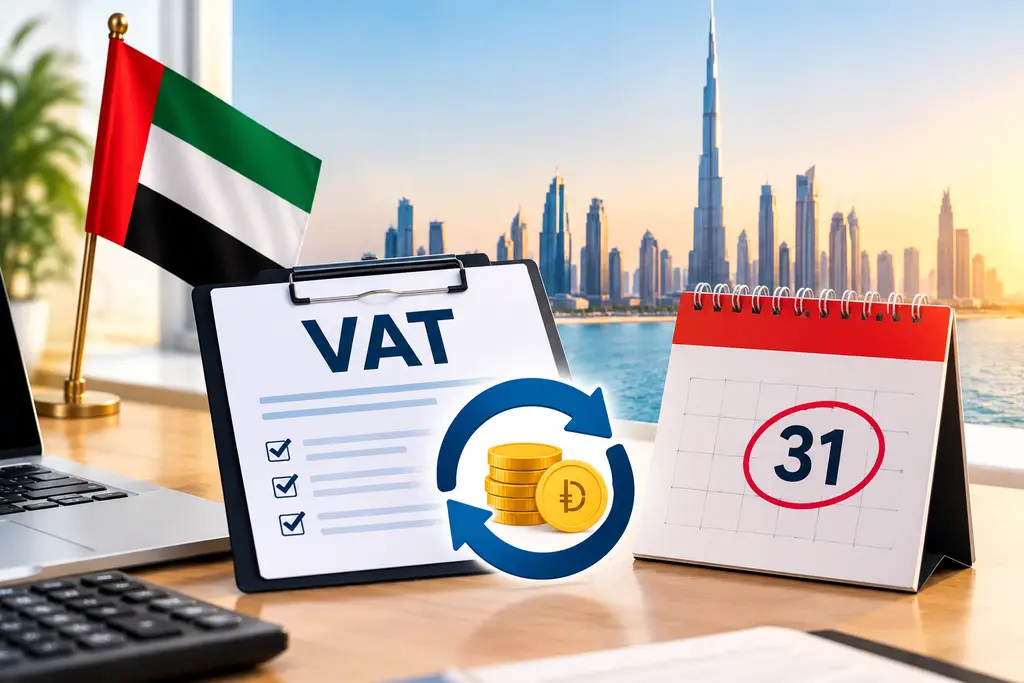
Somewhere in your VAT returns there may be money you have stopped thinking about. A credit from an early quarter, carried forward again and again, has become part of the furniture.
In 2026 that credit gained an expiry date. The UAE VAT refund deadline 2026 is 31 December for businesses whose older balances fall under the new transition rules. With roughly ten weeks left, the question is no longer whether to review your credits. It is how fast you can do it properly.
This article lays out what the rules say, how to judge whether your balance is at risk, and a week-by-week plan to submit a clean claim.
Why Unclaimed VAT Credits Suddenly Matter
The UAE VAT law amendments 2026, introduced by Federal Decree-Law No. 16 of 2025, took effect on 1 January. A matching change to the Tax Procedures Law backs them up.
The headline for refunds is the UAE VAT refund 5-year rule. Excess recoverable input VAT now has a limited life: five years, counted from the end of the tax period that produced it. Before this, no equivalent cut-off existed, which is why so many balances were simply left running.
The same reform package also tightened other areas:
- Reverse charge transactions no longer need a self-generated invoice.
- Input tax can be refused if the supply sits inside an evasion arrangement.
- Taxpayers are expected to take reasonable steps to confirm a supplier is genuine before deducting VAT.
The direction is clear. Less paperwork on routine items, but more scrutiny on refunds and supplier quality.
Is Your Credit at Risk? A Quick Self-Test
Answer these questions for each carried-forward amount.
- Which tax period created it? Add five years to the end of that period.
- Does that date fall before 1 January 2026? If yes, it is already past the standard limit and depends on the transition rule.
- Does it fall in 2026? Then it also depends on the transition rule, because the standard period ends within a year.
- Does it fall in 2027 or later? The normal five-year clock still has time, but you should note the date.
The transition rule is the safety valve. For balances in the first two groups, the VAT refund deadline 31 December 2026 is the last date to submit a request. The rule also allows a voluntary disclosure within two years of that request, provided the FTA has not yet ruled on it.
A simple illustration
A logistics company ended a quarter in 2021 with excess input VAT and kept rolling it forward. Its five-year period runs out in 2026. Unless a refund request is filed by 31 December, the company risks losing the amount. This is an illustration, not a real case, but it shows how an ordinary-looking carry-forward turns into a deadline.
Exceptions That Change the Clock
Three situations follow their own timing:
- Credits created by an FTA decision. If the balance appears because of an FTA decision after the five-year period, or in its final 90 days, you generally get one year from the date the balance arose.
- Claims filed in the last year. Submitting in the fifth year gives the FTA two extra years from the filing date to audit or assess that claim.
- Claims during an audit. FTA Decision No. 9 of 2025 sets out when the authority may decline to release residual amounts for someone under audit.
The second point is easy to overlook. Filing late does not only risk missing the date. It can also keep the claim open to challenge for longer.
Your 10-Week Countdown Plan
Today is 22 October. Here is a realistic schedule to reach a safe filing date.
Weeks 1–2: Inventory. List every credit balance by tax period and calculate its five-year end date. Rank them by urgency.
Weeks 3–4: Reconcile. Match ledger entries to filed returns. Flag differences and decide which ones need correction.
Weeks 5–6: Evidence and suppliers. Collect invoices, customs papers and payment proof. Review your largest suppliers and note how you confirmed they are genuine.
Weeks 7–8: Corrections and filing. File any needed voluntary disclosures. Then submit your refund request in the UAE VAT refund process FTA portal, using the VAT refunds section to open a new request.
Weeks 9–10: Buffer. Respond to FTA questions, add missing documents and keep a log of every message. Do not plan to file in this stage. It exists for surprises.
Check the current FTA portal screens before filing, because layouts and requirements can change.
What to Put in the File
For most UAE VAT refund for businesses claims, a strong file contains:
- Tax invoices that meet the legal requirements
- Customs declarations for imports
- Proof that suppliers were paid
- Contracts, delivery notes or service records
- The filed returns for the periods involved
- A reconciliation between your ledger and those returns
- Confirmed bank details on your FTA account
A short cover note explaining how the balance built up also helps a reviewer understand the claim quickly.
How Long Will the FTA Take?
No official figure applies to every case, so be careful with anyone who promises one. Timing depends on claim size, document quality and whether the FTA asks questions or opens an audit.
Older and larger claims usually get closer attention. A clear, well-organised file tends to cause fewer follow-ups. That is the strongest argument for filing well before the final days of December.
Why Claims Get Rejected or Reduced
The most frequent VAT refund rejection reasons UAE claimants face include:
- Filing after the allowed period
- Invoices missing required details
- Figures that do not agree with filed returns
- Suppliers that cannot be verified
- Earlier errors that were never corrected
- Residual amounts withheld because of an active audit
Notice that most of these are preventable. They come from preparation gaps, not from the law itself.
Old Credit, New Rules: What Can You Still Recover?
Many owners ask whether an old balance can still be recovered. The answer depends on the period it came from and the date you file. Balances covered by the transition rule can be pursued until year-end. Balances still inside their normal five years can be claimed in the usual way.
Either way, a proper review should also tell you whether you face a possible FTA VAT refund audit, so you can prepare for it in advance.
Building Audit-Ready Habits
Refund claims invite questions. These habits make them easier to answer:
- One reconciliation file per claim
- Documents stored so any invoice can be found quickly
- A short written note on how each key supplier was checked
- Returns and accounts that match each other
Good bookkeeping makes everything above simpler. Our VAT compliance and bookkeeping service keeps records claim-ready, and a VAT health check shows weak spots early. If the FTA announces an inspection, VAT audit support helps you prepare.
When a claim is reduced or refused, a VAT reconsideration request is the formal route to challenge it. If you discover mistakes in past returns, voluntary disclosure lets you fix them before the FTA finds them.
When to Bring in a VAT Refund Consultant in Dubai
A single small claim with tidy records can often be done internally. Specialist help earns its fee when:
- The amount is large or spans several years
- Early records are missing or scattered
- You suspect errors in earlier returns
- Your transactions are cross-border or sector-specific
- An audit is under way or likely
Accruon Auditing LLC is a government-recognised audit firm in Dubai. As VAT refund consultants in Dubai, we review historic credits, prepare filings and handle FTA correspondence. Read about our VAT refund services and broader VAT consultancy, or start from the Accruon Auditing LLC to see everything we offer.
Final Thought
A VAT credit used to be an asset you could leave alone. Now it is one you have to manage. The five-year limit rewards businesses that track their balances and punishes those that do not.
For older credits, 31 December 2026 is the line. The best response is calm and methodical: list, date, reconcile, file, and keep a buffer. Start this week and you will have time to correct problems instead of racing the calendar.
Want to know exactly which of your credits are still recoverable? Book a free VAT refund review with Accruon and get a clear picture before the year ends.