
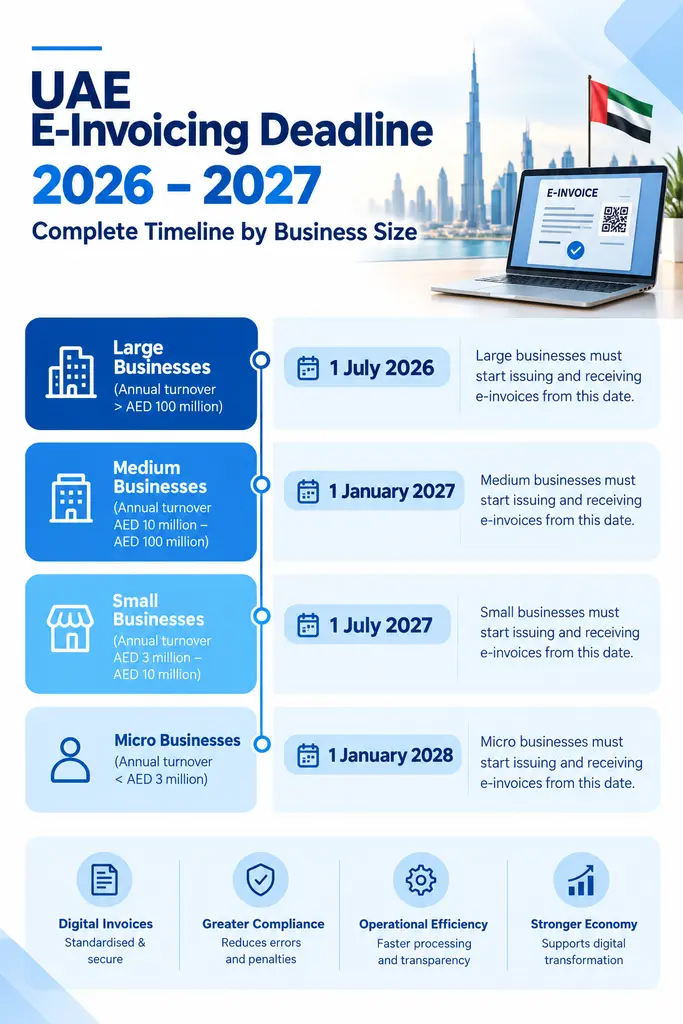
Many finance teams in the UAE still treat e-invoicing as a 2027 problem. It isn’t. The first UAE e-invoicing deadline falls on 30 October 2026, and that date applies to your supplier decisions, not just your go-live.
If you are asking “does this apply to me, and by when?”, the answer depends on your annual revenue. This guide gives you the UAE e-invoicing timeline 2026 and the UAE e-invoicing mandate 2027 dates for each business size. It also covers what the rules require and how to prepare.
What Is UAE E-Invoicing, and Why Is It Different from a PDF Invoice?
A PDF invoice is not an e-invoice. Under the UAE system, an invoice must be a structured digital file that systems can read automatically. It travels through a network and is reported to the tax authority.
The UAE uses a decentralised, five-corner model built on Peppol. Your invoice moves from your system to your accredited service provider (ASP), across the network to your customer’s ASP, and then to your customer. Invoice data is also reported to the Federal Tax Authority (FTA).
Three points matter before you read the dates:
- You cannot connect to the network on your own. You must appoint an ASP.
- Invoices must follow a prescribed data standard, not just look correct.
- Your ERP or accounting software must produce the right data in the right structure.
UAE E-Invoicing Phase 1 and Phase 2 Dates at a Glance
The UAE e-invoicing phases are set by Ministerial Decision No. 244 of 2025 and its later amendment. In that amendment, the Ministry of Finance moved the Phase 1 ASP appointment date from 31 July 2026 to 30 October 2026. The go-live date did not move.
| Business category | Revenue threshold | Appoint an ASP by | Mandatory go-live |
|---|---|---|---|
| Phase 1: large businesses | AED 50 million or more | 30 October 2026 | 1 January 2027 |
| Phase 2: smaller businesses | Below AED 50 million | 31 March 2027 | 1 July 2027 |
| Government entities | Not applicable | 31 March 2027 | 1 October 2027 |
A voluntary pilot programme has also been running since 1 July 2026. Participants in the voluntary or pilot stage are not subject to the e-invoicing administrative penalties.
UAE E-Invoicing Revenue Threshold: AED 50 Million Explained
The UAE e-invoicing revenue threshold of AED 50 million decides your phase. It is a dividing line between “Phase 1” and “everyone else”, not an exemption.
Falling below it means you go live six months later. It does not mean you are out of scope. Free zone companies follow the same thresholds. A free zone business above AED 50 million is in Phase 1, and one below it is in Phase 2.
Check how revenue is measured in the Ministerial Decision before you assume which side of the line you are on. Groups with several entities should test each legal entity separately. If you are close to the line, get a professional opinion before you decide.
Deadline by Business Size
Large Businesses (AED 50 Million and Above)
You have the shortest runway.
- By 30 October 2026: appoint an ASP.
- From 1 January 2027: issue and receive compliant e-invoices.
In practice, ASP onboarding, ERP configuration and data cleanup take months, not weeks. If you have not signed with an ASP yet, this is your most urgent task. Your CFO or finance head should own the decision, because it affects billing, tax and IT together.
Mid-Sized Companies and the Wait-and-See Trap
Mid-market firms often sit just under the AED 50 million line. The extra six months is useful, but it is also a trap. Your biggest customers may be in Phase 1 and could ask you for compliant invoices earlier. Large buyers rarely want to process non-compliant invoices once their own systems are live.
Small Businesses (Below AED 50 Million)
The UAE e-invoicing deadline for small businesses is 31 March 2027 to appoint an ASP, with go-live on 1 July 2027. Smaller businesses often use simpler accounting software, so the work is lighter. The risk is that ASP capacity tightens as the Phase 2 date approaches, and late appointment attracts penalties.
Government Suppliers and B2G Sellers
The UAE e-invoicing B2B and B2G requirements cover both business-to-business and business-to-government transactions. Government entities themselves must appoint an ASP by 31 March 2027 and go live by 1 October 2027. If you sell to government bodies, expect your customers to ask about compliance well before their own go-live.
Who Must Comply? VAT-Registered Businesses and Scope
The UAE e-invoicing for VAT-registered businesses rules sit alongside VAT law. Scope is defined in Ministerial Decision No. 243 of 2025. In general it is built around B2B and B2G transactions, with certain exclusions. Don’t assume your sector is excluded without checking.
If your VAT records are not clean, e-invoicing will expose the gaps. A VAT health check before you integrate with an ASP can catch data and classification problems first.
UAE Federal Tax Authority E-Invoicing Rules: What the System Requires
The UAE Federal Tax Authority e-invoicing rules and the Ministry of Finance framework come down to a few practical obligations:
- Issue invoices and credit notes through an ASP, in the required structured format.
- Use your TIN as your network identifier. It is the first 10 digits of your corporate tax registration number.
- Include all mandatory fields, including line-level quantity, unit price, tax category, tax rate and AED equivalents.
- Notify the FTA promptly if a system failure prevents e-invoicing.
- Store invoice data in line with the retention rules.
Peppol and the PINT AE Data Model
The UAE Peppol e-invoicing requirements rest on the national adoption of Peppol PINT. The UAE e-invoicing PINT AE data model defines which fields are mandatory and how they must be structured.
This matters for your ERP. Each required field needs a source in your system. Missing item codes, inconsistent units of measure and incomplete customer tax data are the most common problems.
Choosing an Accredited Service Provider
The UAE e-invoicing accredited service provider (ASP) is the gateway to the network. Ministerial Decision No. 168 of 2026 took effect on 1 October 2026 and changed how providers are accredited, replacing the earlier pre-approval model. It regulates providers, not your own deadlines.
When you compare providers, ask about:
- Accreditation status under the current decision
- Integration with your ERP or accounting software
- Onboarding timeline and support
- Handling of credit notes, failures and reporting
- Pricing structure and contract terms
UAE E-Invoicing Penalties for Non-Compliance
The penalty framework is set by Cabinet Decision No. 106 of 2025. The main UAE e-invoicing penalties for non-compliance are:
- AED 5,000 per month, or part of a month, for failing to implement the system or appoint an ASP on time.
- AED 100 per invoice, capped at AED 5,000 per calendar month, for failing to issue and transmit an e-invoice.
- AED 100 per credit note, capped at AED 5,000 per calendar month, for the same failure on credit notes.
- AED 1,000 per day for failing to notify the FTA of a system failure.
These can stack. A business that misses its ASP deadline and also fails to transmit invoices can face AED 10,000 a month before other penalties. The financial risk is real, but the operational risk is bigger. If invoices cannot be issued or accepted, collections slow down.
UAE E-Invoicing Compliance Checklist
Use this UAE e-invoicing compliance checklist to test your readiness:
- Confirm your phase using your revenue and legal entity structure.
- Review your VAT and corporate tax registration details for accuracy.
- Clean customer and supplier master data, including TINs and addresses.
- Map every mandatory PINT AE field to a source in your system.
- Shortlist and compare ASPs.
- Sign the ASP agreement before your deadline.
- Test invoices and credit notes in a sandbox environment.
- Train finance, sales and IT staff on the new workflow.
- Document internal controls and error-handling procedures.
- Plan retention and archiving of e-invoice data.
UAE E-Invoicing Implementation Roadmap: How to Prepare
A practical UAE e-invoicing implementation roadmap has five stages. Here is how to prepare for UAE e-invoicing, whichever phase you are in.
- Assess. Confirm scope, phase and the systems that create invoices. These often include more than one ERP, billing tool or point-of-sale system. An accounting system analysis shows where your current setup falls short.
- Select. Choose an ASP and agree on integration scope.
- Integrate. Configure or upgrade your ERP so it generates the required data. If your current software cannot do this, ERP implementation support may be the better route than patching it.
- Test. Run real transaction scenarios, including credit notes, discounts, multi-currency invoices and corrections.
- Go live and monitor. Track rejections, delays and exceptions from day one.
Link this work to your wider tax position. E-invoicing data will feed your VAT returns, so your VAT compliance bookkeeping process should be ready for it. For businesses without in-house finance leadership, virtual CFO services can own the project end to end.
Common Mistakes to Avoid
- Using the old 31 July 2026 date. The Phase 1 ASP deadline is now 30 October 2026.
- Treating “below AED 50 million” as “exempt”. It only means a later date.
- Leaving ERP changes until the end. Data mapping takes longer than most teams expect.
- Ignoring free zone entities in a group. They follow the same thresholds.
- Assuming your accountant will handle it alone. It needs finance, IT and sales working together.
Free zone businesses already juggle several deadlines. Our guide to statutory audit requirements in UAE free zones shows how to avoid clashes with your audit calendar.
Final Thought
The UAE e-invoicing deadline is a phased timeline, but the preparation window is shorter than it looks. For Phase 1, the decision point is 30 October 2026. For Phase 2, it is 31 March 2027. Start by confirming your phase and your system gaps. Then pick an ASP early, while onboarding capacity is still available.
Not sure which phase you fall under or whether your systems are ready? Talk to the team at Accruon Auditing LLC for a practical e-invoicing readiness review before your deadline