
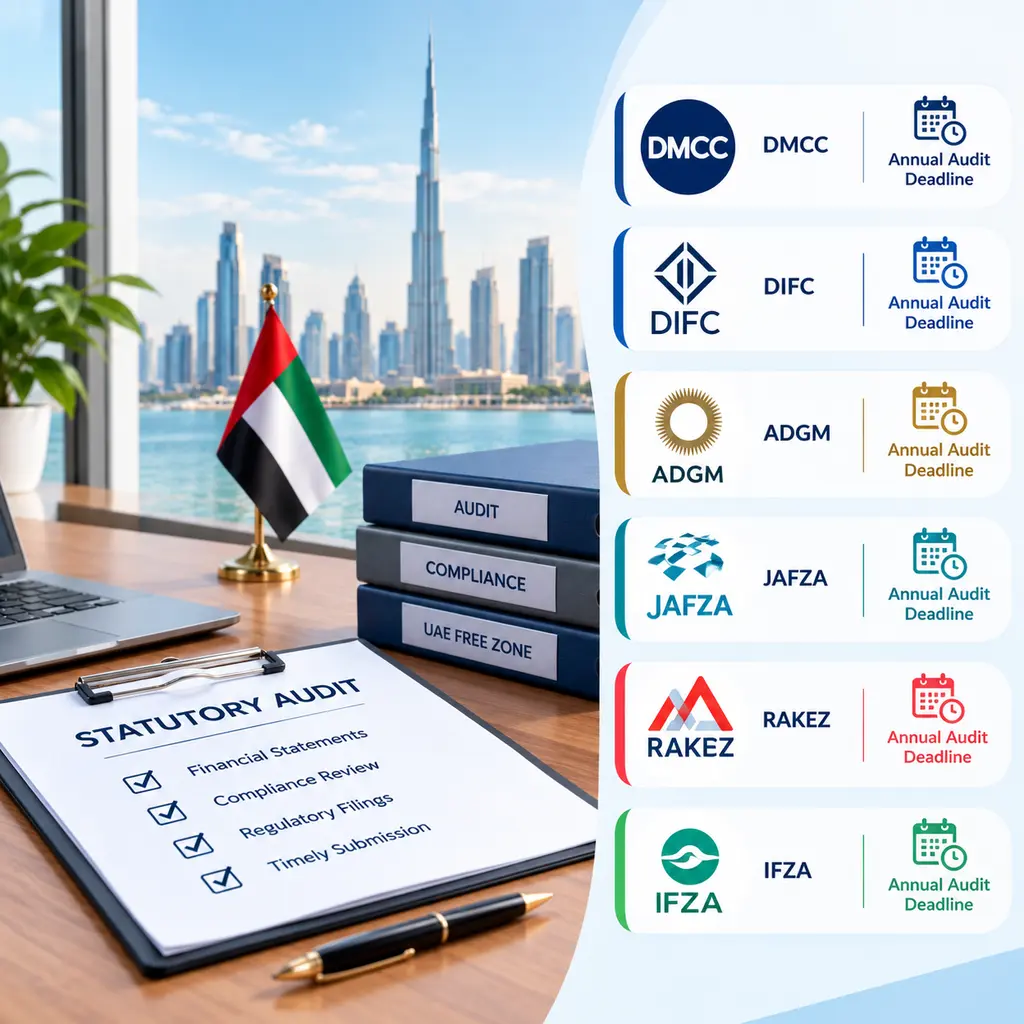
When you ask ten free zone owners when their audit will take place, you’ll get ten different answers. This is because each authority, and not one federal calendar, determines the statutory audit requirements in UAE free zones 2026.The deadline is dependent on the jurisdiction of your license and the end of your financial year.
The dates for each of the key authorities are outlined, along with an illustration of how the audit connects to corporate tax, and an explanation of the consequences of missing a deadline.
The reasons for different audit deadlines in free zones.
Each authority has its own rulebook, portal and approved auditor panel, so the statutory audit requirements in UAE free zones 2026 are never identical from one zone to the next. That’s why audit deadline by free zone authority UAE is such a common search.
Two things set your date: your financial year-end and your authority’s filing window. Corporate tax adds a third. The filing deadline falls nine months after the financial year closes, and the figures must come from audited accounts.
Is an annual audit mandatory for companies set up in a UAE free zone?
In most cases, yes. Mandatory audit for UAE free zone companies is applicable to DMCC, JAFZA, DAFZA and RAKEZ regardless of the revenue and dormant companies are not exempt.. IFZA expects audited statements at licence renewal. DIFC and ADGM depend on entity type.
There is also a tax reason. A qualified free zone person audit requirement applies if you want the 0% rate on qualifying income.
Deadlines by Authority: 2026 Reference
| Authority | Window from year-end |
| DMCC | 6 months |
| JAFZA | Commonly 90 days (confirm) |
| DAFZA | Commonly 90 days (confirm) |
| DIFC | 4 months for DFSA-authorised firms |
| ADGM | 9 months (private), 6 months (public) |
| RAKEZ | 6 months |
| IFZA | At licence renewal |
DMCC: The DMCC audit report submission deadline is six months, per DMCC’s own guidance. For a 31 December 2025 year-end, that meant 30 June 2026..
The requirement for annual audited financial statements at JAFZA and the annual audit requirements under DAFZA are typically referred to as 90 days.
DIFC: The DIFC audit filing deadline is four months for DFSA-authorised firms. For non-regulated companies, sources disagree, so check with the DIFC Registrar.
ADGM: Under the Companies Regulations, the ADGM annual audited accounts deadline is nine months for private companies and six for public ones.
RAKEZ, IFZA and SHAMS: RAKEZ expects filing within six months, from an auditor on its own approved list. IFZA requires audited statements at renewal, mandatory since 30 September 2025. For SHAMS, check its current guidelines.
How Your Audit Connects to Corporate Tax
Your audit does double duty. Consider a trading company in a free zone with a 31 December 2025 year-end. Its authority may want the audit by March or June 2026, and its corporate tax return is due by 30 September 2026. If the audit slips, both dates are at risk.
That’s why we handle free zone corporate tax advisory and corporate tax return filing alongside the audit.
Submit your audit after the cutoff and a UAE free zone can charge you a fine, hold back your licence renewal and slow down your visas and banking until the file is in.
Restricted services. Visa processing and establishment card updates can be held up.:
- Fines, which differ by authority. ADGM publishes a graded scale.
- Blocked licence renewal, the most common consequence.
- Service holds on visas and establishment cards.
- Tax exposure, if weak records put QFZP status in question.
The fine is rarely the biggest cost. A stalled renewal can freeze banking and visa processes.
Free Zone Audit Checklist UAE 2026
- Confirm your year-end and your authority’s deadline.
- Check your auditor against your authority’s approved auditor list for UAE free zones. The lists are not interchangeable, and you can see where Accruon is listed on our approved free zone authorities page.
- Reconcile bank statements for the full year.
- Prepare an IFRS compliant audit report UAE free zone authorities will accept.
- Get board sign-off and upload through the correct portal.
- Align the audit date with your tax return date.
If you’re still comparing firms, our guide to the best statutory audit firms in Dubai covers what matters beyond firm size.
Final Thought
Deadlines are easier to meet when you plan backwards from them. Know your authority, know your year-end, and book your auditor before the year closes, not after.
Accruon Auditing LLC brings more than 25 years of experience and approvals with leading free zone authorities. Our statutory audit services and free zone compliance audit cover your authority filing and tax position together.
Lorem ipsum dolor sit amet, consectetur adipiscing elit. Ut elit tellus, luctus nec ullamcorper mattis, pulvinar dapibus leo.
Frequently Asked Questions
Must a UAE free zone company get its accounts audited every year?
Yes, in most free zones. DMCC, JAFZA, DAFZA and RAKEZ require annual audits, and IFZA requires them at renewal. DIFC and ADGM depend on entity type.
When are DMCC audited financial statements due for the 2026 filing cycle?
Six months after year-end. For a 31 December 2025 year-end, that was 30 June 2026.
Must my company be audited in order to qualify as a Qualifying Free Zone Person?
Yes. Audited financial statements are part of maintaining QFZP status.
Can I use any auditor?
No. Most authorities require an auditor from their approved panel.
What if I don’t submit it on time?
Fines, refusal of licence renewal and service restrictions will apply. Some authorities accept extension requests made before the deadline.